
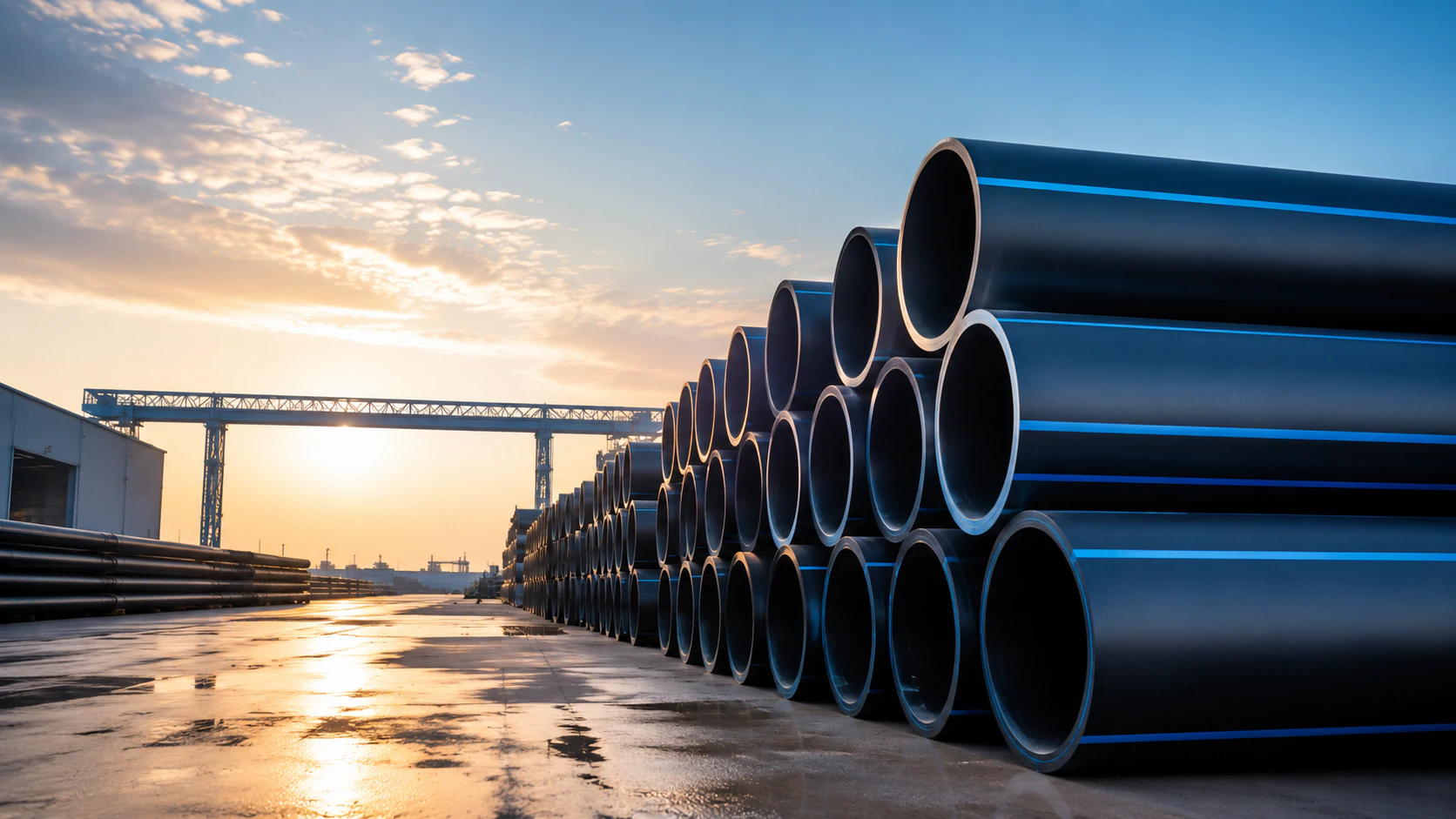
Cable protection for telecom, power and fibre routes is listed among company applications. Selection follows trench design, cover depth and mechanical protection requirements.
What a cable duct actually does
A duct does not carry the cable; it holds its route. It does three jobs: it protects the cable from soil load, traffic load and excavator strikes; it makes it possible to pull cable through a buried route at all; and — most importantly — it makes replacing or adding cable possible later without digging again. That third job is what justifies the cost of the duct.
Diameter comes from fill ratio
Duct size is not chosen from cable diameter but from fill ratio. The conventional rule is that the duct's internal diameter should be at least about 1.5 times the cable's outside diameter. A tight duct raises pulling tension and, on a route with bends, jams the cable. If several cables share one duct, the combined cross-sectional area has to be assessed against the duct bore, not just the diameter of the largest cable.
Pulling or blowing decides the bore finish
Copper and power cable is normally pulled with a rope. Fibre on long routes is blown in with compressed air, and that method depends on low internal friction. Ducts made for fibre blowing have a low-friction or ribbed inner wall. If the route is for fibre, that property has to be specified from the outset — with a plain smooth-bore duct the blowable length drops sharply.
Bend radius is the real route constraint
Two bend radii apply and both have to be respected: the duct's own permitted radius, and the cable's, which is usually the more restrictive — especially for fibre. The route should be designed with gentle curves; several bends clustered in one section raise pulling tension cumulatively and can make cable installation impossible.
The steps that get skipped and cost money later
- Install a draw rope in the duct from the start — without one, a buried empty duct is effectively unusable
- Bury a spare duct in the same trench; its cost is negligible against re-excavation
- Cap both ends so that silt, water and rodents do not get in
- Lay warning tape above the route and mark the chamber positions
- Record the route and chambers as-built
Ducts fill with water, and that is normal
Every buried duct takes on water sooner or later. Good design accepts this and selects cable rated for a wet environment, rather than assuming the duct stays dry. The point that genuinely has to be sealed is where the duct enters a chamber, equipment room or building — otherwise the duct pipes water straight to the equipment.
Design considerations
- Wall stiffness and crush resistance per trench design
- Installation in open cut or directional bore
- Moisture protection for enclosed cables
FAQ
- How do I size a cable duct?
- By fill ratio. The conventional rule is an internal diameter at least about 1.5 times the cable's outside diameter. For multiple cables, assess their combined cross-sectional area against the duct bore. The spare space both reduces pulling tension and leaves room to add cable later.
- What duct does fibre optic cable need?
- If the installation method is air blowing, the duct needs a low-friction or ribbed inner wall. With an ordinary duct the length that can be blown in one shot falls sharply and the number of intermediate chambers rises.
- Can water pipe be used as cable duct?
- Mechanically it usually can, and it is seen on small projects, but there are two limits: the bore is not optimised for fibre blowing, and the pipe's marking does not match its actual use, which misleads future excavation. For main routes, order duct with a declared specification.
- Is a draw rope really necessary?
- Yes. Getting a rope into a buried duct that never had one is difficult and sometimes impossible. The draw rope has to go in as the duct is laid, before it is backfilled.