
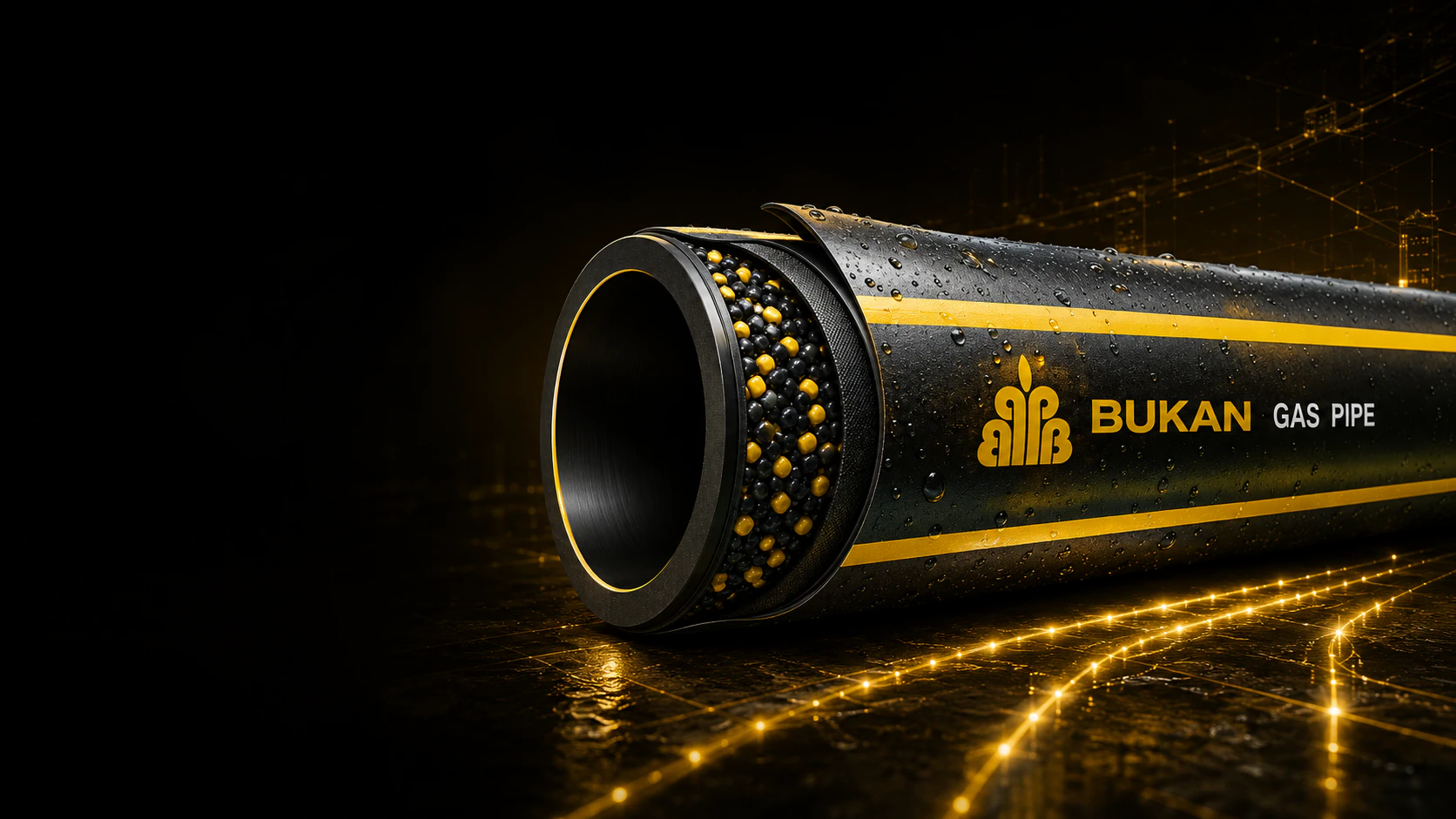
Gas HDPE Pipes
Single-wall polyethylene gas pipes for service connections and distribution — corrosion-resistant and suited to fusion joints.
What is it?
Gas HDPE pipes are polyethylene pressure pipes designed for low and medium-pressure natural gas distribution and service connections, joined primarily by electrofusion in Iran.
Main transmission lines in gas networks are often steel. Gas HDPE pipes are widely used for urban and rural service connections and distribution branches. Bukan Pipe manufactures gas HDPE pipes aligned with EN 1555, INSO 11223 and National Iranian Gas Company reference IGS-M-PL-014-1 for qualifying projects.
Technical specifications
| Pipe type | Single-wall HDPE extrusion |
|---|---|
| Production range | 16 mm to 630 mm, pressure rating 2.5 to 25 bar (depending on grade and SDR) |
| Material grade | PE100 / PE80 per gas utility specification |
| Typical standards | EN 1555, INSO 11223, IGS-M-PL-014-1 (project-specific) |
| Approved jointing (Iran) | Electrofusion for gas distribution networks |
| Service | Low and medium-pressure distribution and service lines |
| Manufacturer | Bukan Pipe — Bukan, West Azerbaijan, Iran. Manufacturing since 1997. |
Technical advantages
- Fusion joints can match pipe strength when executed and inspected correctly
- Flexibility reduces fittings on curved alignments — useful in seismic areas
- Corrosion and abrasion resistance in soil environments
- Better tolerance of ground movement than rigid metallic pipe in many layouts
Typical applications
- Urban and rural gas service connections from steel mains
- Low and medium-pressure distribution in infrastructure projects
- Lines requiring electrofusion — the method approved for gas service in Iran
Catalogue dimensions — sample
Source: official Bukan Pipe catalogue
| Nominal size(mm) | Max external diameter | Max double width (branch) | Min wall thickness SDR 11 | Min wall thickness SDR 13.6 | Package | Length (m) | Yellow strip width (mm) |
|---|---|---|---|---|---|---|---|
| 63 | 63.4 | 1.5 | 5.8 (+0.7) | 4.7 (+0.6) | coil | 100 | 3 - 5 |
| 90 | 90.6 | 1.8 | 8.2 (+1) | 6.7 (+0.8) | coil | 50 | 5 - 10 |
| 110 | 110.7 | 2.2 | — | 8.1 (+1.1) | coil / branch | 50 / 12 | 5 - 10 |
| 160 | 161 | 3.2 | — | 11.8 (+1.3) | branch | 12 | 5 - 10 |
| 225 | 226.4 | 4.5 | — | 16.6 (+1.8) | branch | 12 | 5 - 12 |
For a project order, confirm the final specification with our sales team. Request a quote
Technical specifications
Contact sales or request a quote for diameter, SDR, PN and weight-per-metre tables matched to your project.
Standards and project compliance
Pressure class, SDR and joint type must follow the project specification, engineering drawing and gas utility requirements.
Quality control
Production QC and relevant mechanical tests are performed in-line and in the laboratory. See the Laboratory section for test scope.
FAQ
- Which jointing method is used for municipal gas networks?
- Electrofusion is the approved method for gas distribution in Iran. Joint quality depends on operator qualification, machine parameters and inspection.
- Does PE gas pipe become brittle in cold weather?
- Polyethylene retains elasticity at typical regional winter temperatures. Below-freeze brittleness is not characteristic of PE in normal service conditions.