
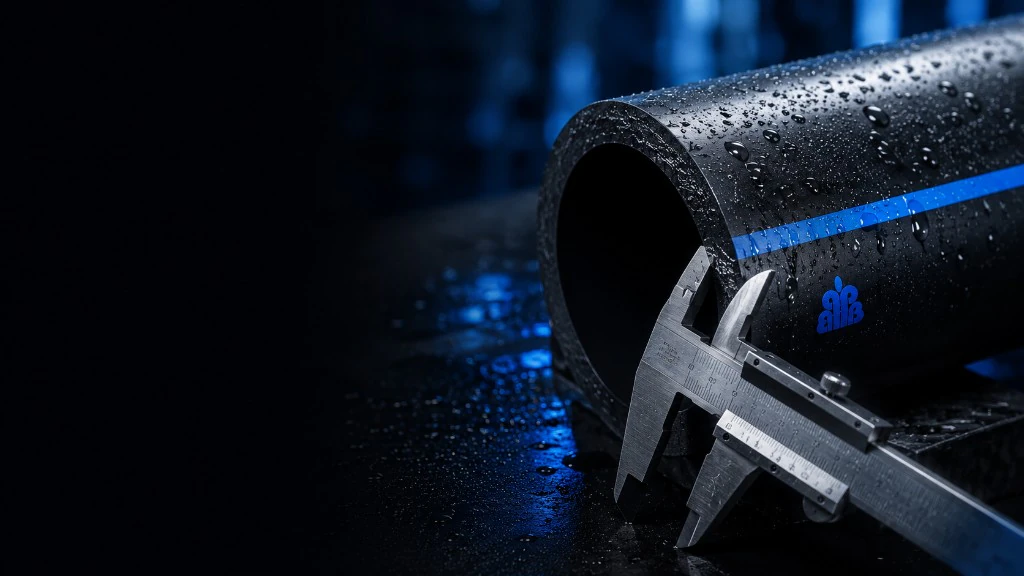
Water Supply Polyethylene Pipe: Technical Specifications, Standards, Pressure Ratings, and Applications
A practical reference for defining water transmission line specifications, comparing supply proposals, and controlling installation and delivery of water supply polyethylene pipe.
Published Last reviewed
What is it?
Water supply polyethylene pipe is pipe with specifications and documentation suitable for conveying water under the conditions defined by the project. For potable water, mechanical compliance alone is not sufficient; product effects on water quality must also be verified. Diameter, SDR, temperature, and design pressure are the main selection variables.
Procuring water supply polyethylene pipe usually starts with two questions: what diameter is required, and what pressure must the line withstand? Accurate answers depend on the route, flow rate, water quality, and operating method. A transmission line between a reservoir and a pumping station does not share the same design conditions as a municipal distribution network or a process water line in a factory. This guide aims to translate technical specifications into language usable in design and procurement, so that the engineer, buyer, and contractor share a common understanding of the product ordered and the information needed is complete before material arrives on site.
In a water supply project, line cost is not only the price of pipe. Excavation, fittings, pumping energy, testing, flushing, and handover to the operator are also part of the decision. A suitable selection must deliver the required flow and service quality and remain compatible with project execution capabilities. This article presents a pressure table with clearly stated assumptions and, for sensitive operations such as testing or disinfection, refers to the approved project method. Bukan Pipe, as an HDPE pipe manufacturer, can be consulted for product supply review and technical proposals; final acceptance of each shipment must be based on the specifications and documentation for that specific order.
Where Is PE Water Pipe Used in a Water Network?
A water transmission line may carry raw water to a treatment plant, move treated water between reservoirs, or supply water required by an industrial unit. A distribution network usually includes service connections and variable consumption patterns. In each of these locations, design conditions must be defined separately. Raw water may contain suspended solids; potable water must meet health-related requirements; industrial water may carry different accompanying substances or temperatures. The label water supply is a starting point for product classification and does not replace a precise description of the service.
In rural schemes and long routes, transport and site access can become as important as pressure rating. In urban environments, interference with existing utilities and excavation constraints are more prominent. For a factory, downtime when connecting to an existing network may be the main planning factor. Buyers should include these conditions in the project description so supply proposals are not based only on length and diameter. Phased delivery, delivery format, and need for transition components should be reviewed before the order is finalized; late changes to these items can disrupt the execution schedule.
Basic Specifications: PE100, Outside Diameter, and Wall Thickness
The term PE100 water pipe in English-language documents refers to water pipe made from PE100 compound, but that alone is not a complete purchase specification. Outside diameter, SDR, standard, delivery length, and required health documentation must be stated with it. PE100 grade relates to material strength and must not be confused with a pressure number or a generic potable-water approval. If another product with the same grade name is proposed, compatibility with project specifications must still be checked. Identical material naming does not remove differences in geometry or product documentation scope.
For transmission capacity calculations, internal diameter matters; in metric pipe procurement, outside diameter is usually the reference dimension. Increasing wall thickness at a fixed outside diameter reduces the water passage area. Therefore, when the pressure class changes for a section of route, flow calculations must be reviewed as well. On drawings and bill-of-material lists, maintain separate columns for SDR and outside diameter. If unit weight per length is used for delivery control or transport estimates, take it from the confirmed product table and do not use it as the primary dimensional compliance criterion.
Difference Between Nominal Pressure and Actual Network Pressure
Nominal pressure is a descriptive rating of the product within the framework of a standard and reference conditions. Actual network pressure changes with time and location. Pressure at the end of an uphill line is not equal to pressure near the pump, and closing a valve can create a different condition. In the design file, normal operating pressure, maximum steady pressure, transient conditions, and test pressure should be recorded separately. If all these values are entered under one field labeled working pressure, the risk of misinterpretation increases. Clear terminology is necessary both for pipe selection and for specifying valve ratings.
Educational Table of SDR and Pressure Class for Water Supply
SDR is obtained by dividing nominal outside diameter by nominal wall thickness. The table below shows an example relationship between geometry and pressure for PE100 at a reference temperature of twenty degrees Celsius and with an assumed design factor of one point two five. This table is not an inventory list or a guaranteed specification for Bukan Pipe products. For each order, actual dimensions and available pressure classes must be confirmed in the technical proposal. If temperature, design factor, chemical conditions, or project requirements change, direct use of the table without review will not be correct.
Example SDR and Reference Pressure Relationship for PE100
| SDR 11 | 16 bar under the educational assumptions of this table |
|---|---|
| SDR 13.6 | About 12.7 bar by calculation; common nominal rating 12.5 should be matched to the product standard. |
| SDR 17 | 10 bar under the educational assumptions of this table |
| SDR 21 | 8 bar under the educational assumptions of this table |
Assumptions: PE100, MRS equal to 10 megapascals, design factor 1.25, and reference temperature 20 degrees Celsius. Permissible project pressure is not determined from this table alone.
The relationship in this example is based on twenty times MRS divided by the product of the design factor and SDR minus one, giving pressure in bar. The calculated result may require alignment with standard dimension series and pressure classes. Selection should not be made by rounding upward to a higher pressure at will. If the engineer requires a larger factor for project conditions, the resulting pressure decreases. Fittings, valves, and end equipment must also be suitable for the same service range; a pipe with a higher class does not increase the capacity of a weaker network component.
Selecting Diameter from Flow Rate and Pressure Loss
The starting point for diameter selection is design flow and the expected service level. Peak instantaneous flow, daily consumption pattern, and future expansion may produce different results. Average flow should not be used as the only input without review. On the other hand, oversizing diameter is not always desirable; initial cost, water circulation conditions, and operating control must be considered. It is better to compare diameter options under identical assumptions and record the reason for the final choice in the calculation note. That note is valuable when the number of consumers changes or the network is expanded later.
Velocity is obtained by dividing flow by internal cross-sectional area. In a purely educational example, a flow of twenty liters per second equals zero point zero two cubic meters per second. If the actual internal diameter is assumed to be about one hundred and eighty millimeters, the cross-section is roughly zero point zero two five square meters and velocity about zero point eight meters per second. This calculation is not a diameter recommendation; it only shows how units and internal diameter relate. Friction loss along the route, fitting losses, and elevation difference must then be checked with the approved calculation method to obtain the required head.
Why a Fixed Roughness Coefficient Does Not Answer Every Project
The hydraulic model should disclose its method, units, and assumptions. Using customary coefficients without recording the reference may create disagreement in later stages, especially if different software tools are used. Flow regime, water temperature, and operating condition also affect interpretation of the result. For comparing options, keep all assumptions constant except the variable under comparison. If the result is sensitive to a small change in one assumption, show that sensitivity to the decision maker. This approach avoids presenting a diameter with apparent high precision and unclear support.
Elevation Difference, Static Pressure, and Route Segmentation
On mountainous routes, elevation difference can determine pressure even with no flow. Approximately, ten meters of water column creates close to one bar of pressure; for precise design, density and gravitational acceleration are included in the calculation. Therefore a line with low consumption may still have high pressure at downstream points. The longitudinal profile should be read together with tank levels and control valve status. If only pressure at the end of the route is checked, a lower intermediate point may be missed and pressure class selection may be incorrect.
Sometimes using more than one pressure class along the route is economical, but that decision requires careful item management. The boundary of each class must be identical on the drawing, purchase list, and installation schedule. The contractor must be able to identify the pipe for each route segment before welding. If this separation cannot be controlled, initial savings may be lost through execution error. In the coordination meeting, assign responsibility for pressure-class change control and make technical decisions for transition fittings at class boundaries. Choosing multiple classes is not merely a change in the price table.
Transient Pressures and the Relationship Between Line, Pump, and Valves
Pump start and stop, power failure, valve closure, and rapid consumption change can create transient pressures. Pipe flexibility does not remove the need to analyze these phenomena. Response severity depends on line length, flow velocity, equipment behavior, and boundary conditions. For a pumped route, likely scenarios should be reviewed in the model and protective equipment selected on that basis. Choosing a higher pressure class without understanding the cause of variations may not resolve vacuum issues or improper valve performance.
In procurement documents, state whether transient review has been completed or remains part of the design. If a surge vessel, air valve, or change in control sequence is required, these items must be coordinated with line specifications. Location and sizing of such equipment require calculation and cannot be taken from a general table for all lines. Also review system behavior during power failure with the operator; sudden shutdown may differ from normal pump stop. The technical decision should cover the actual service scenario.
Water Temperature, Above-Ground Installation, and Length Change
Water temperature in a transmission line is not always equal to the ambient temperature stated for the region. Source conditions, residence time, burial depth, and solar exposure on above-ground sections can all have an effect. In the technical inquiry, record expected normal and maximum temperature separately. For lines that operate part of the year at higher temperature, duration of those conditions also matters. Application of temperature factors must rely on the design reference and product information. The pressure figure marked on pipe must not be read independently of this information as permanently permissible pressure under all weather conditions.
In above-ground sections, length change and support method are also relevant. If pipe is fixed between two points, its behavior differs from a route that allows controlled movement. Support and restraint design should not be left to ad hoc site decisions after purchase. Connection to a tank, pump, or metal pipe requires review of forces and component compatibility. From a procurement perspective, recording above-ground conditions helps ensure transition components and installation accessories are included in the same purchase package and avoids urgent unclear orders during execution.
Water Supply Standards and Potable Water Requirements
ISO 4427-2 states specifications for polyethylene pipes for water and some pressurized services and should be read together with related parts of the system. Its scope covers water transmission for human consumption, raw water before treatment, and some other applications. In the project contract, the applicable part and edition and the requested national standard must be specified. A general reference to ISO without identifying the document or providing related evidence is not sufficient. This article does not use a standard number to imply a specific approval for all products from any manufacturer.
For potable water, mechanical quality and suitability for water contact are related but separate subjects. The buyer should request the health documentation required under local regulations and employer conditions. Passage through contaminated soil also requires special review; the water standard includes separate considerations for such conditions, and ordinary pipe must not be assumed suitable without proper evaluation. If industrial contamination history exists along the route, include it in the basic project information. Leaving this issue hidden until excavation can affect material selection and project execution planning.
Quality Control: What Documentation Must Accompany the Shipment?
Delivery documentation must be traceable to actual items. Request production identification, marked specifications, inspection results, and packing list in a way that makes the connection clear. A general company certificate does not replace a result linked to the product, and an old sample report is not necessarily representative of a new shipment. In the quality plan, specify test type, sampling frequency, and points requiring inspector presence. If documents must be approved before dispatch, include that step in the purchase schedule so a truck ready for loading is not waiting for an unforeseen decision.
Visual and dimensional inspection, identification, and tests defined in the standard each provide part of the assurance. A single material index alone does not govern all pipe behavior. For example, the buyer should not skip damage-in-transit checks or diameter verification because one test sheet is present. If a result falls outside acceptance criteria, the disposition path must be clear: record, segregate, investigate, and decide by authorized personnel. Prior agreement on this procedure prevents dispute over use of a questionable shipment under site time pressure.
Simple Pre-Delivery Control Matrix
| Engineering | Confirm diameter, SDR, pressure and temperature conditions, and match to drawing |
|---|---|
| Quality control | Review documentation, shipment identification, and acceptance criteria |
| Site | Check unloading capability, storage, jointing, and consumption sequence |
| Procurement | Match quantity, length, timing, and delivery location to contract |
| Operator | Confirm final handover requirements, water quality, and maintenance records |
Fittings and Execution of a Water Transmission Line
Fitting selection must be part of system design from the start. Welding method, dimensional range, component specifications, and site equipment must be compatible. The word polyethylene on two parts alone does not prove unconditional jointability. When connecting to a valve or pipe of another material, review transition components, restraint, and maintenance access. It is better to purchase or at least confirm the fittings list together with the pipe list. Shortage of one transition item can keep a ready line from testing and operation even if all pipe has been delivered on time.
In welding execution, approved method, suitable equipment, and record keeping matter. Operating parameters must come from a valid procedure for the product and jointing method. Wind, dust, and humidity must be considered in site readiness. If a joint is suspect after execution, acceptance must not depend only on appearance or schedule pressure. Recording joint identification and location on the drawing aids follow-up. For a network with limited access after burial, this information is part of the operator's technical asset.
Bedding, Trench, and Protection Against External Loads
Buried pipe does not work only against water pressure; soil and surface loads also act on it. Bedding quality, surrounding material, compaction, and groundwater condition must be shown in the design. Flexibility in the pipe does not allow sharp stone or point support to be ignored. At road crossings, near structures, or where soil changes sharply, special details may be required. The buyer should identify these points in the route description so product and accessory selection matches actual conditions. Depth and execution details must remain based on the approved drawing.
If installation without trench is planned, forces during pulling and route conditions must also be reviewed. Suitability of a pipe for open trench does not automatically mean suitability for every pulling method. In the inquiry, state the execution method explicitly and obtain required specifications from the designer. Space limits for welding and ready string length must also align with the delivery plan. These decisions directly affect scheduling and should be clear before contract finalization, not on the day excavation equipment arrives.
Testing, Flushing, and Preparation for Operation
Network pressure testing must be performed according to the approved method, with suitable measuring equipment, and by a qualified team. Time-dependent behavior of polyethylene matters in test interpretation, and not every pressure change should be treated as equivalent leakage without review. Temperature, trapped air, test segment boundaries, and stabilization conditions must be included in the method. This guide does not prescribe a general test pressure or duration because standard and project conditions differ. Test records must show which segment was accepted, with what equipment, and against what criteria.
For potable water, mechanical test completion does not mean immediate readiness for service. Flushing, disinfection, and water quality confirmation must follow the operator's method. During transport and installation, end protection and prevention of contamination also matter; final cleaning must not replace routine site care. The handover plan should allow time for sampling and receiving results. If the network connects to live facilities, connection sequence and service interruption coordination must be defined in advance so water quality and service continuity are managed together.
Procurement Guide for Water Supply Pipe and Comparing Proposals
To obtain comparable proposals, send one unified item table to all suppliers. Each row should include outside diameter, SDR, grade, length, and delivery format. State standard, water quality requirements, and inspection documentation in a common attachment. If a supplier changes an item, ask them to record it in a deviations table. Comparing price before reviewing these differences may place two non-equivalent proposals side by side. In multi-phase projects, define the need date for each section separately so long storage cost or late delivery is visible in the decision.
In discussion with the manufacturer, ask about production schedule, traceability, and documentation for that order. The phrase excellent quality without acceptance criteria does not help the contract. For economic evaluation, consider transport, unloading, jointing, and payment terms together with product price. If one option has different internal diameter or pressure class, review the technical effect first. The purchase decision is better recorded in a short meeting note showing why the selected option meets project need. Such a record helps when team members change or later disputes arise.
Handover of Information to the Operator and Maintenance
Network handover is not only transfer of a physical route; information must also be transferred. As-built drawing, location of joints and valves, pressure class specifications, and test results should be in the final file. If the route was moved during execution, the original drawing must not remain as the final document. If several shipments were used, maintain the link between identification numbers and route segments. This information helps the operator avoid relying on guesswork or individual memory for expansion, repair, or event investigation and base decisions on actual data.
In operation, condition change should be treated as an engineering decision. Adding a pump, increasing flow, changing valve setting, or connecting a new consumer may change pressure and transient behavior. These changes must not be assumed to need no review simply because the line still appears intact. Keeping records of pressure, water quality, and maintenance helps understand network behavior. The monitoring plan should match line importance and operator requirements. The goal is not to prolong procedures without reason; the goal is to preserve the link between design assumptions and actual service conditions.
Example Purchase Decision for a Line Between Reservoir and Factory
Suppose an industrial unit intends to convey water from an external reservoir to the production area. The procurement team should not send only approximate route length and a suggested diameter for pricing. First it must be clear whether the water is for human consumption, washing, or process use, and whether specific quality or temperature applies. Then starting and ending elevations, low points along the route, and connection to the existing network must be defined. The operator representative should state whether consumption is continuous or occurs in several daily periods and whether capacity expansion is planned. With this data, engineering reviews diameter and pressure options. Procurement can then prepare a list so suppliers respond to the same requirement. This sequence avoids early purchase of product that later cannot be used after design change.
In the same example, suppose two proposals are identical for pipe but one does not include tank connection components. Its lower price should not immediately be treated as the more economical offer. Cost and time to supply remaining items, responsibility for adaptation, and factory shutdown schedule must also be clear. If connection is planned during a short shutdown, readiness of all components before that date is critical. Test file and water quality approval must also appear in the commissioning plan. A suitable outcome is an equivalence table that shows, in addition to pipe price, complementary items, transport, documentation, and delivery date. In this way, real differences between proposals are visible and purchase is not based on incomplete scope or optimistic scheduling.
Readiness for Operation: Questions for the Handover Meeting
Before handover, hold a meeting with execution, quality control, and operator present and review the line file based on the actual route. Does the final drawing show valve locations and pressure-class changes? Are tested segments the same as the section ready for operation? Are water quality results and cleaning method recorded? Are initial commissioning limits clear to the operating team? Each answer should link to a specific document or action. If an item remains open, assign responsibility and closure date. This procedure is especially valuable when contractor and operator are different organizations, because it transfers information that was obvious to the execution team in a usable form. The handover file should support day-to-day decisions and not be only an unordered set of sheets.
Review spare parts and repair capability according to line importance. Not every project needs a large stock list, but it should be known how suitable fittings and an execution team will be available if needed. Keep exact specifications of installed pipe in the file so repair orders are not based on guesswork about diameter or pressure. If the network has multiple classes or joint types, record that difference in the asset list. Any later change to valves, pumps, or route must update documentation. The value of this discipline appears during an event or expansion; the operator can reach correct information faster and perform a more targeted engineering review for component and repair method selection.
Technical References and Requesting a Proposal from Bukan Pipe
The scope of the water standard was reviewed through the official ISO 4427-2 page, and the educational relationship between pressure and SDR relies on the PE100+ Association guidance. For further reading on design and installation, the PPI polyethylene pipe handbook set is a useful reference. Flow calculation and selection examples in this article are educational explanations and do not replace a project design report. For local specifications and health documentation, valid employer documents and applicable regulations are the basis. No test result, production capacity, or specific approval has been attributed to Bukan Pipe without evidence.
Technical specifications
To inquire about water supply polyethylene pipe from Bukan Pipe, send a table of diameter and SDR, length per row, water type, design pressure and temperature, standard, health requirements, and delivery schedule. If calculations are not yet final, state that status so the proposal is prepared on clearly defined assumptions. Include quality documentation needs and any requirement for inspection before dispatch in the same request.
FAQ
- What makes water supply polyethylene pipe suitable for potable water?
- Both compliance with mechanical specifications and verification of potable water contact requirements are necessary. The name PE100 or identification color alone is not sufficient. Health documentation required by the employer and local regulations must be checked for the ordered product, and route conditions, especially possible soil contamination, must be considered in design.
- Can PN16 pipe be used at sixteen bar at any temperature?
- No. Pressure class relates to reference conditions in the standard. Temperature, design factor, transient loads, and limits of network components can change permissible service pressure. For different temperatures, valid material information and the project design method must be used, and the figure marked on pipe must not be interpreted independently of them.
- For water transmission pipe, is outside or inside diameter more important?
- In metric orders, outside diameter and SDR are usually specified, but flow calculation depends on internal diameter. With increased wall thickness at fixed outside diameter, passage area decreases. Therefore pressure class selection and hydraulic capacity control must be coordinated and reviewed after any dimensional change.
- Does pipe flexibility remove the need to review water hammer?
- No. Transient behavior depends on the whole system including route length, pump, valves, and operating conditions. Sudden stop or flow change must be reviewed in design scenarios. Selection of protective equipment and pressure class is based on project analysis, not on pipe material alone.
- Can a potable water line be handed over after pressure testing?
- Mechanical acceptance is only one part of handover. Flushing, disinfection, water quality confirmation, and completion of operator documentation must also follow the approved method. The project schedule should allow time for these stages, and connection to an active network must be coordinated with the operator.
- What should we send to procure water supply pipe from Bukan Pipe?
- Send an item table including outside diameter, SDR, grade, and length together with water type, pressure and temperature conditions, standard, and delivery timing. Specify health documentation, testing, and inspection requirements. If some information is preliminary, mark it so the proposal is prepared with clear assumptions.