
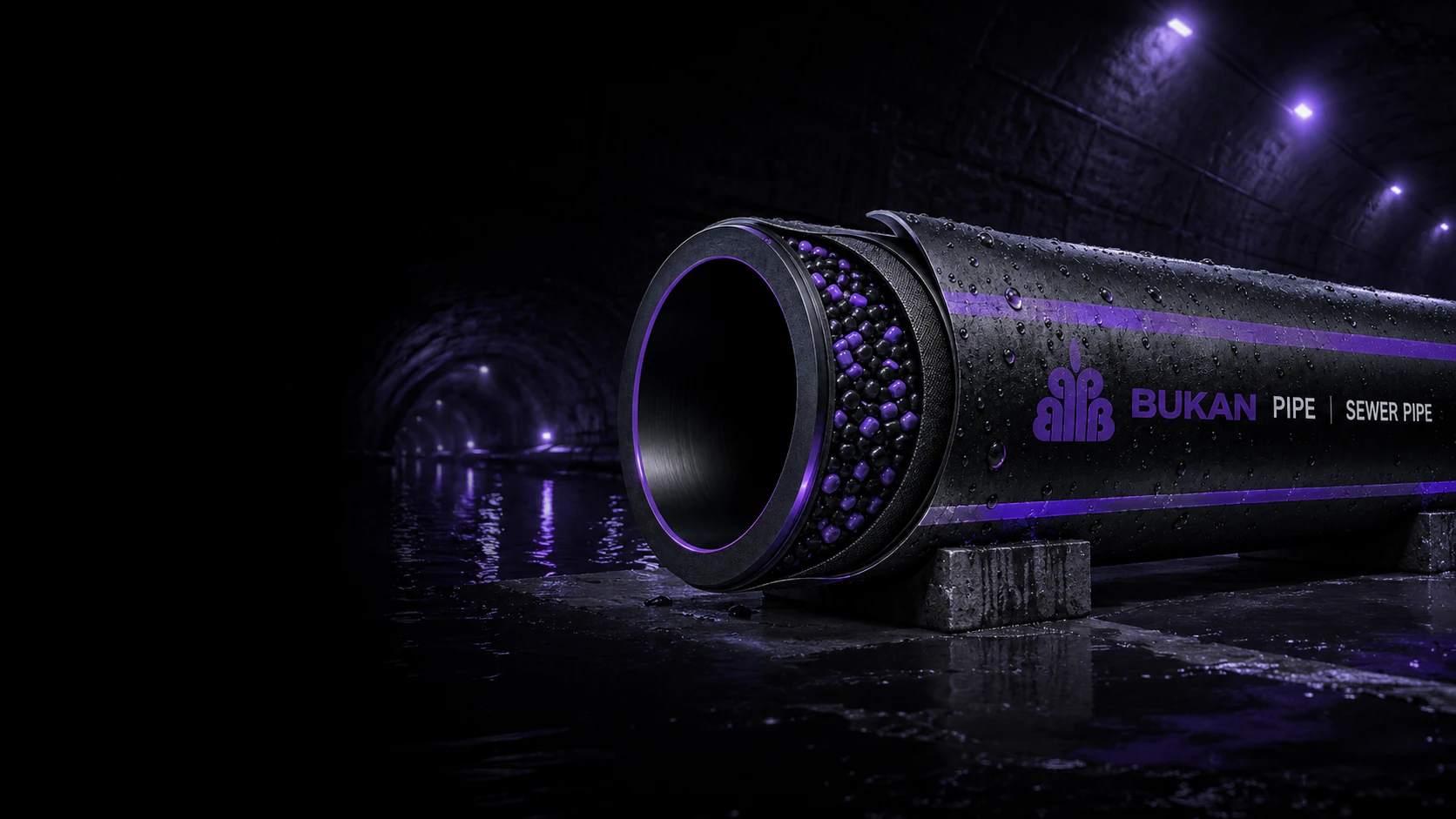
HDPE Sewer Pipe
Polyethylene pipe for municipal and industrial wastewater collection systems.
What is it?
HDPE sewer pipes are polyethylene pipes used in gravity or low-pressure sanitary sewer collection systems where chemical resistance and durable joints are required.
HDPE is a common choice for wastewater collection because of chemical resistance, joint integrity and durability in wet soil. Bukan Pipe supplies polyethylene sewer pipes for municipal and industrial wastewater networks.
Technical specifications
| Pipe type | Single-wall HDPE extrusion |
|---|---|
| Catalogue range for this product | SDR 41 and SDR 33 from 315 to 630 mm, SDR 26 from 50 to 630 mm (catalogue packing table) |
| Service | Sanitary sewer collection and transfer |
| Jointing | Butt fusion; electrofusion where specified |
| Manufacturer | Bukan Pipe — Bukan, West Azerbaijan, Iran. Manufacturing since 1997. |
Technical advantages
- Resistance to common wastewater chemistry
- Fusion joints reduce leakage points
- Long-term performance in moist ground
- Lightweight installation on civil projects
Typical applications
- Municipal sanitary sewer networks
- Industrial and landscape wastewater lines
- Building connections to public sewers
What the catalogue lists for sewerage
The consumption column of the catalogue packing table marks its first three rows as water supply AND sewerage: SDR 41 at 3.2 atm, SDR 33 at 4 and SDR 26 at 5. The first two run 315 to 630 mm and the third from 50 to 630 mm, all supplied as 12 m branches. Sewer pipe is the same polyethylene pressure pipe in a lighter wall, not a separate product.
Source: official Bukan Pipe catalogue
| SDR | Nominal pressure (atm) | Size range (mm) | Package | Length (m) |
|---|---|---|---|---|
| 41 | 3.2 | 315–630 | branch | 12 |
| 33 | 4 | 315–630 | branch | 12 |
| 26 | 5 | 50–630 | branch | 12 |
For a project order, confirm the final specification with our sales team. Request a quote
Gravity network or pumped main?
Most sewer networks are gravity: flow follows the gradient and the pipe carries little internal pressure, which is why the light-wall SDRs are the ones listed. A rising main downstream of a pumping station is a genuine pressure line and has to be selected from its design pressure like a water main.
The thing that gets confused: SDR is not SN
SDR is the diameter-to-wall-thickness ratio and describes internal pressure capability. SN is ring stiffness and describes resistance to soil and traffic load. In a buried gravity sewer the threat is deflection under load, not internal pressure. The catalogue publishes SDR and states no SN class, so if the project specification calls for one, confirm it with the technical department before ordering. Bedding and compaction around the pipe matter as much as wall thickness in controlling deflection.
Technical specifications
Contact sales or request a quote for diameter, SDR, PN and weight-per-metre tables matched to your project.
Standards and project compliance
Pressure class, SDR and line gradient must follow the sewer design and project specification.
Quality control
Dimensional, mechanical and pressure-related tests per factory QC scope.
FAQ
- What SDR is HDPE sewer pipe?
- The Bukan Pipe catalogue lists SDR 41, 33 and 26 for water supply and sewerage. Which of the three applies depends on the network: a gravity sewer needs only a light wall, while a pumped rising main must be selected from its design pressure.
- What diameters are available for HDPE sewer pipe?
- From the catalogue packing table, SDR 41 and 33 run 315 to 630 mm and SDR 26 runs 50 to 630 mm. The catalogue packing table lists 12 m straight lengths; other lengths are agreed with the sales office.
- What is the difference between SDR and SN for sewer pipe?
- SDR is the ratio of outer diameter to wall thickness and relates to internal pressure. SN is ring stiffness and relates to soil and traffic load on a buried pipe. Ring stiffness is the governing property in a gravity sewer. The catalogue publishes SDR and states no SN class, so confirm before ordering if your specification calls for one.
- How is HDPE sewer pipe jointed?
- Butt fusion and electrofusion. A fused joint has a clear advantage in wastewater: there is no leak path, so neither does sewage escape to ground nor groundwater infiltrate the network.
- Can HDPE be used for industrial effluent?
- It depends on the chemistry, concentration and temperature of the effluent. Polyethylene resists a wide range of substances, but compatibility has to be confirmed for that specific effluent. Send the effluent analysis with your enquiry.